
➀Purpose
・The profile grinding machine was handling a large volume of work, resulting in a disparity in workload between the surface grinding machine and the profile grinding machine within the company.
・We want to assign some of the machining tasks to the NC surface grinding machine to boost productivity and improve utilization rates.
②Key Points for Implementation
(Challenge)
In shape machining on NC surface grinders, 90% of the causes of poor shape accuracy stem from shape errors resulting from the grinding wheel’s tip shape becoming worn and no longer perfectly circular, which prevents tool diameter compensation from being accurately applied. We want to accurately determine the shape and use that information to improve accuracy.
(Solution)
To achieve machining accuracy at the 0.002 mm level on an NC surface grinder, it is essential to accurately understand the grinding wheel tip shape, which is the key factor determining shape accuracy.
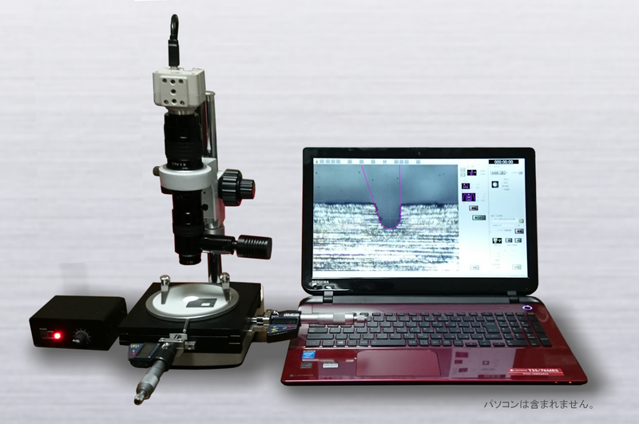
● With Point Nine PG CAM II...
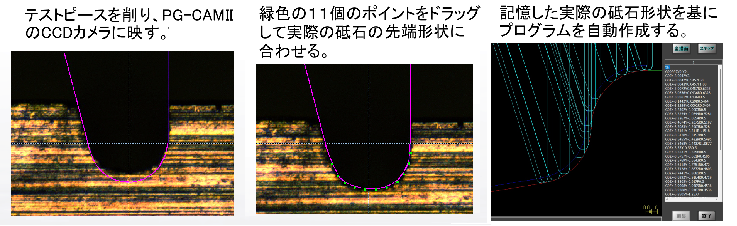
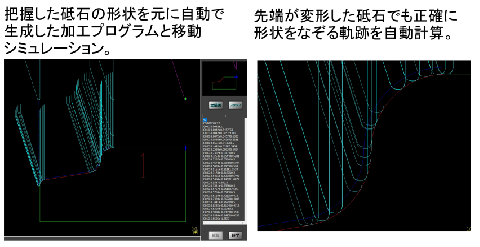
・You can automatically generate machining programs to machine the target shape based on the grinding wheel’s tip profile.
・Because you can accurately determine the grinding wheel’s tip profile, the system can automatically create machining programs that answer the question: “How should the grinding wheel be moved to machine a DXF shape based on the actual tip profile of the grinding wheel, without using tool diameter compensation?”
③Examples
We machined a test piece on the machine tool and captured it with a CCD camera to determine the actual shape of the grinding wheel’s tip. We then used CAD software designed specifically for this system to automatically generate a toolpath (i.e., a machining program) based on the determined grinding wheel shape for machining the target shape, transferred it to the NC controller, and performed the machining.
④Results
・Since flat grinding machines could only achieve a machining accuracy of approximately 0.02 to 0.04 mm,finishing was performed on a profile grinding machine. With the introduction of this system, we are now able to consistently achieve an accuracy of ±0.003 mm, eliminating the need for the profile grinding process.
・Shape accuracy, which previously varied by ±3 to 5 μm, achieved ±0.002 mm accuracy in a single pass during the demonstration run.
・We were able to decentralize processes that had been concentrated on the profile grinding machine, thereby increasing productivity.
・We are now able to consistently perform shape machining with accuracy in the 1000th of a millimeter range even on NC cylindrical grinding machines.
Recommended for those facing these concerns or challenges
I want to easily improve machining accuracy on NC surface grinders and NC cylindrical grinders. I want to machine with confidence.
Here are the benefits you can expect from implementing this!
- It enables you to improve machining accuracy in the shortest possible time.
- Achieves a machining accuracy of 0.002 mm—a level previously thought impossible with NC surface grinders.
- Even inexperienced operators can perform high-precision machining.
- The risk of the grinding wheel colliding with the workpiece is drastically reduced.