
➀Purpose
In the past, the standard process was: (1) Machining → (2) Measurement → (3) Re-machining → (4) Measurement → Re-machining…
We aim to shorten lead times by achieving a perfect finish in a single pass!
②Key Points for Implementation
With the equivalent slow-away end mill from another manufacturer that we had been using,
the wall surface finish accuracy for finishing a 20 mm vertical wall was 14–17 μm.
In particular, due to tool runout and deflection, there was significant material left behind near the bottom surface.
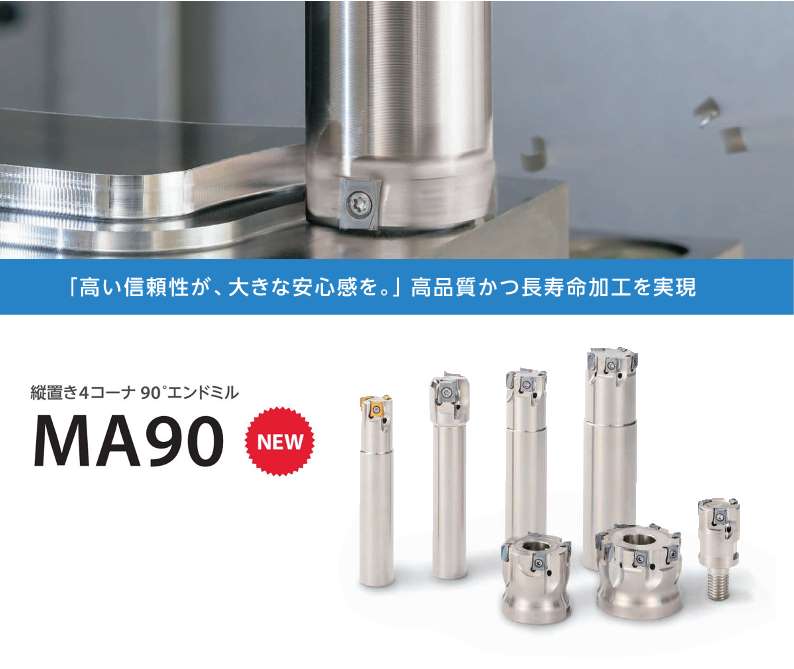
With the MA90, for the same machining operation, wall surface accuracy reached 6 μm—a 2- to 3-fold improvement in machining accuracy compared to conventional tools!
As a result, re-machining became unnecessary, and we succeeded in significantly shortening the production lead time.
③Examples
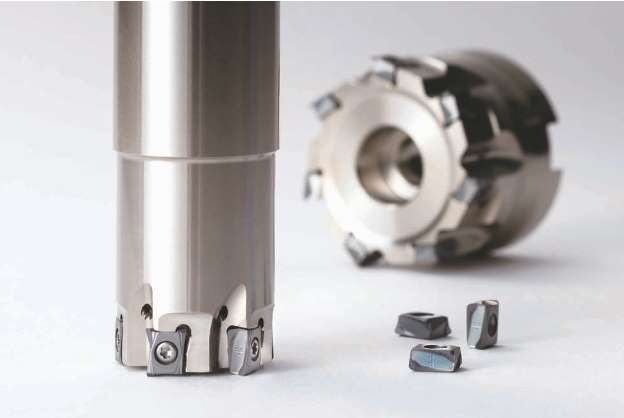
Using a Kyocera “Vertical 4-Corner 90° End Mill MA90” with a 20 mm diameter and three cutting edges on a BT50 machining center.
Workpiece material: S50C; finishing of a 20 mm straight vertical wall.
Peripheral speed: 150 m/min
apxae: 3 x 5 mm; 4 passes
Dry machining
④Results
When finishing 20 mm vertical walls, we were able to achieve the required wall surface accuracy within the target tolerance in a single machining operation,
eliminating the need for the conventional process of (1) machining → (2) measurement → (3) re-machining → (4) measurement → re-machining... and so on.
As a result, we achieved a significant reduction in production time and were able to automate the measurement and corrective machining processes that had previously been performed manually.
Furthermore, in addition to improved machining accuracy, the use of FCD in machining has increased insert durability by 1.6 times compared to the tools previously used, leading to cost reductions due to lower insert consumption.